Revival: Taiwan's National Security: Dilemmas and Opportunities (2001) by Alexander C. Tan & Steve Chan
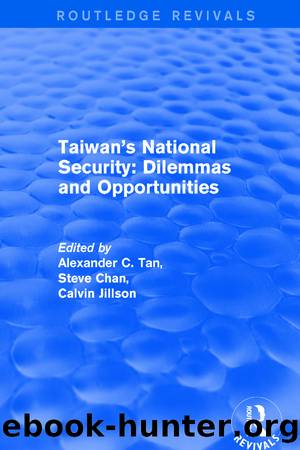
Author:Alexander C. Tan & Steve Chan [Tan, Alexander C. & Chan, Steve]
Language: eng
Format: epub
Tags: Political Science, General
ISBN: 9781351749770
Google: jJguDwAAQBAJ
Goodreads: 35866885
Publisher: Routledge
Published: 2017-07-28T00:00:00+00:00
Lee Teng-hui and Cross-Strait Relations
To well explain the surge of Taiwanese nationalism since the early 1990s, we have to turn our attention to the role of the political elites in the construction of new group identity, for political elites are by nature specialists in the mobilization of grievance and hope, especially on the issue of nationalism. From early on, DPP leaders have built their electoral support upon the native Taiwanese peopleâs shared sense of deprivation and misery. The DPP leadership played up the issue because this salient cleavage cuts across socioeconomic strata. Nationalism was viewed as an effective counter strategy to the KMTâs broadly-based socio-economic development program and an issue that could unite the DPP supporters of different social and economic interests under a common cause.17 However it was the power struggle within the KMT after the passing of Chiang Ching-kuo that critically turned the tide against the prevailing official ideological claim on Chinese identity. The intra-party struggle came to a point of no return in early 1990, when Lee Teng-hui was challenged by his Mainlander rivals in the KMTâs party nomination for presidential candidate. It was also the turning point for the growth of Taiwanese nationalism.
Although Lee Teng-hui was extremely cautious in playing the role of a nominal leader during the first two years of his presidency, various Mainlander factions still held him personally responsible for their loss of power and the rise of Taiwanese independence movement. The 1990 presidential election provided the anti-Lee forces a timely opportunity to jointly challenge Leeâs leadership. However, the social unrest stirred by the power struggle within the KMT eventually led to a massive student movement, demanding for a thorough political reform. Faced with challenges from inside and outside the party, Lee made a critical decision to collaborate with the pro-reform forces in pushing for democratization. By inviting the opposition to participate in the cross-party National Affairs Conference, Lee not only successfully isolated the conservative camp, but also legitimatized his reform plans, including abrogating the Temporary Provision, revising the Constitution, and re-electing national representatives.
At this moment, Lee knew quite well that once democratization began its course, the confrontation between Taiwanese nationalism and Chinese nationalism would quickly surface because there was no more reason to exclude anyone from participating in the democratic process. To ease resistance of Chinese nationalists on the island and to maintain stability across the Taiwan Strait, Lee made another crucial decision soon after the holding of the National Affairs Conference, that is, the establishment of the National Unification Council under the Presidential Office. The Council later issued a set of National Unification Guidelines, which views Taiwan (ROC) and mainland China (PRC) as two parallel political entities (states) and divides the pursuit of a unified China into three stages (short term, mid term and long term). The strategic thinking behind Leeâs announcing of the Guidelines was to provide a functional framework for maintaining domestic and international stability so as to buy time for Taiwanâs democratization and his power consolidation.18
Basically, Lee Teng-hui adopted a pragmatic approach toward the issue of nationalism.
Download
This site does not store any files on its server. We only index and link to content provided by other sites. Please contact the content providers to delete copyright contents if any and email us, we'll remove relevant links or contents immediately.
| Anthropology | Archaeology |
| Philosophy | Politics & Government |
| Social Sciences | Sociology |
| Women's Studies |
The Secret History by Donna Tartt(19088)
The Social Justice Warrior Handbook by Lisa De Pasquale(12190)
Thirteen Reasons Why by Jay Asher(8909)
This Is How You Lose Her by Junot Diaz(6886)
Weapons of Math Destruction by Cathy O'Neil(6279)
Zero to One by Peter Thiel(5802)
Beartown by Fredrik Backman(5754)
The Myth of the Strong Leader by Archie Brown(5507)
The Fire Next Time by James Baldwin(5444)
How Democracies Die by Steven Levitsky & Daniel Ziblatt(5218)
Promise Me, Dad by Joe Biden(5153)
Stone's Rules by Roger Stone(5087)
A Higher Loyalty: Truth, Lies, and Leadership by James Comey(4963)
100 Deadly Skills by Clint Emerson(4925)
Rise and Kill First by Ronen Bergman(4788)
Secrecy World by Jake Bernstein(4753)
The David Icke Guide to the Global Conspiracy (and how to end it) by David Icke(4718)
The Farm by Tom Rob Smith(4509)
The Doomsday Machine by Daniel Ellsberg(4490)
